
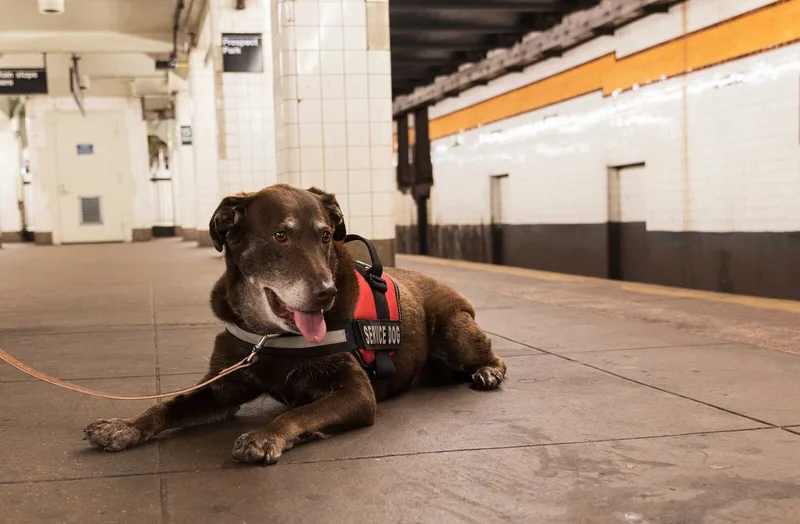
There is a lot of confusion about whether the person coming into a business with a dog is really using a service animal, or if they just can’t stand to be separated from their pet so they pass it off as a service animal when it isn’t. Businesses are only allowed to ask two questions to determine whether it’s a service dog: “Is this a service animal required because of a disability,” and “What work or task has the animal been trained to perform?”
Q. So, how can I know it’s really a service dog and not just a beloved pet that the handler can’t stand to leave behind?
A. You’ll know it’s a service dog if the person can say what the task is. If they can’t tell you a specific task, it’s not a service animal. The handler must answer those questions or they can be asked to remove the dog from the building. They may return without the animal, but the business isn’t required to let the dog stay.
Q. So if they respond by saying, “the dog is helping me remain calm,” do I have to let the dog in?
A. A trained service dog may indeed help them remain calm, but that response is not enough to tell you whether it’s a service dog or not. Again, they must be able to tell you the task the dog does. For example, if they respond, “If I begin to get upset, Fluffy notices and stands up and pokes me with her nose and then pushes her way into my lap and demands attention,” poking her owner with her nose is a task she’s been trained to do. The dog is recognizing cues that her owner’s anxiety is increasing and she is responding by alerting her owner to what’s happening and then reorienting her to the present.
Q. Can I ask for something like an I.D. card that proves the dog is a trained service animal?
A. No. You may not ask for a certification card or a demonstration of the task. There is no official entity that certifies animals as service dogs. There are entities that will take your money and give you a card saying it’s a service animal, but there is no guarantee that the dog is a true service dog based on that. You may not ask for a demonstration of the dog’s task either as it may place the handler in a dangerous situation in order to demonstrate.
Q. If someone comes to my business with a miniature horse, do I have to let it in?
A. That’s more difficult to assess. Miniature horses are also recognized as service animals by the ADA laws. You do have some leeway though to evaluate whether the horse is appropriate for entering your business. It must still be trained for a specific task, and it must be housebroken and under control at all times. You will have to evaluate whether it constitutes a hazard to people in your building.
Q. If someone comes into my store with their dog and says it’s a service dog and then sets it in the grocery cart basket, is that acceptable?
A. There is no law that says the dog must be allowed to ride in the basket of a shopping cart or sit at a table with the handler. It’s okay if you don’t mind it. Otherwise, the handler can carry it, or it should remain on the floor next to them and it should be leashed unless the task it does requires it to move about freely (like going for help if the handler become incapacitated).
Q. What do I do if the person can’t tell me the task the dog has been trained to do for them?
A. Explain that people who misrepresent their dogs as service animals are guilty of a misdemeanor in Michigan, punishable by imprisonment for not more than 90 days, a fine of not more than $500, and community service for not more than 30 days. And, remember, if the person doesn’t respond by telling you the task the dog has been trained to do, you can ask them to remove the animal even if it is a legitimate service dog. If you believe the person is misrepresenting their dog as a service animal, you can contact local law enforcement for further assistance.
Q. If the dog is a service dog, but it’s growling at my customers, jumping on them or causing a disturbance, do I have to allow it to remain?
A. No. While the ADA laws now cover dogs that are in training, the dog must still be under control at all times. That doesn’t mean if it woofs when startled you can ask the owner to remove it, but if the owner doesn’t try to correct any misbehavior and it continues to bark, then you can ask the person to remove the dog from the premises.
As a business owner there is a lot you need to know about service animals and what they can do and where they can go. For more information, please contact Disability Network Lakeshore at 616-396-5326.
Our World still has barriers for people with disabilities.
Whether you're an individual or a company, searching for disability resources is discouraging and frustrating. And when you don't have the right tools, individuals and communities suffer. Wouldn't you like to live in an inclusive community where everyone can participate, contribute, and belong?
The right resources are hard to find. We get it.
We understand how it feels to struggle to fully participate in an inaccessible community, which is why we help people find and use disability resources.
Donate Today To Make a Difference!
Helping others live lives less complicated by disabilities takes people and resources. Support like yours helps us continue helping others struggling to navigate disability resources. 90% of your donation goes directly into services to individuals, their families, and our community.
Make A Donation Today!442 Century Lane
Holland, MI 49423
Services
- Advocacy
- Assistance Animals
- Information & Referral
- Peer Support
- Emergency Readiness
- Social Security Disability
- Social Participation
- Veterans
- Skills Development
- Employment
- Transition
- Nursing Home Transition
- Youth Services
Impact Report
Privacy Policy
UCP of Michigan
Info@dnlakeshore.org
Phone: (616) 396-5326
Fax: (616) 396-3220
Office Hours:
8am-4:30pm M-F
442 Century Lane
Holland, MI 49423
Services
Assistance Animals
Social Security Disability
Social Participation
Employment
Nursing Home Transition
Office Hours: 8am-4:30pm M-F
Privacy Policy
UCP of Michigan
Info@dnlakeshore.org
Phone: (616) 396-5326
Fax: (616) 396-3220