
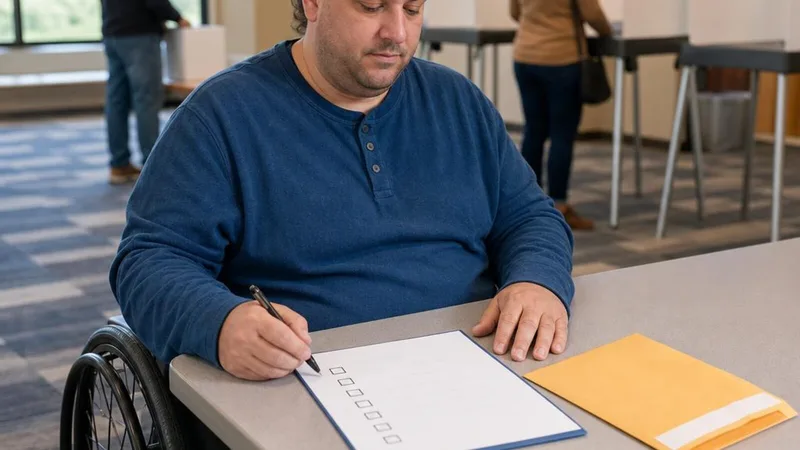
Michigan’s general election is Tuesday, November 3, 2026. A little planning now can make voting less stressful, especially if transportation, communication, mobility, fatigue, sensory needs, or another access concern could create a barrier.
There is no single best way to vote. Michigan voters can vote early in person, vote by absentee ballot, or vote at their polling place on Election Day. The right choice is the one that works for you.
This guide is nonpartisan. It does not tell you whom or what to vote for. It will help you check the practical details and make a plan that fits your needs.
Start by checking your voter information
Go to the Michigan Voter Information Center at Michigan.gov/Vote to:
- Check whether you are registered.
- Review the address on your registration.
- Find your city or township clerk.
- Find your Election Day polling place.
- Find early voting information and absentee ballot drop boxes.
- View your sample ballot when it becomes available.
- Track an absentee ballot.
For this election, online and mail registration are available through Monday, October 19, which is 15 days before Election Day. Beginning Tuesday, October 20, anyone who still needs to register or update their address for this election must do so in person at their city or township clerk’s office and show proof of residency. In-person registration remains available through Election Day. If you are in line at your clerk’s office by 8 p.m. on November 3, the Michigan Department of State says you may register and vote.
The state lists examples of proof-of-residency documents on its voter registration page. Check that page or call your clerk before you go so you know what to bring.
Make a personal voting plan
Write down your answers to these questions:
- How will I vote? Early in person, by absentee ballot, or at my polling place on Election Day?
- Where will I vote or return my ballot? Confirm the location instead of relying on where you voted in the past.
- When will I go? Choose a date and a backup date if you are voting early. If voting on Election Day, think about what time may work best.
- How will I get there? Plan transportation, accessible parking, drop-off, or another option.
- What access supports will I need? This might include curbside voting, a Voter Assist Terminal, help from another person, extra time, communication support, or a quieter time of day.
- Who will I contact if I have a question? Save your clerk’s phone number and the state’s accessible elections contact information.
Option 1: Vote early in person
Early voting offers an experience much like Election Day. You receive a ballot, mark it, and put it into a tabulator at an early voting site.
For the November 3 general election, the required nine-day early voting period runs from Saturday, October 24 through Sunday, November 1, 2026. A community may offer additional days, and beginning in 2026 it may also offer voting on Monday, November 2. Locations and hours are not necessarily the same as your Election Day polling place.
Use Michigan.gov/Vote or contact your clerk to confirm your correct early voting site, dates, and hours before leaving home. If you need an accessibility feature, ask what is available at that location.
Option 2: Vote by absentee ballot
Every registered Michigan voter may vote using an absentee ballot. You do not need to give a reason. Ballots are available beginning 40 days before the election, which is Thursday, September 24, 2026 for this election.
Unless you are already on the permanent absentee ballot list, you must apply before your clerk can send a ballot. You may apply online, by mail, or through your clerk. The state’s deadline for an online application, and for a mailed application to be received, is 5 p.m. Friday, October 30. However, waiting that long may not leave enough time for the ballot to travel through the mail. The Michigan Department of State recommends applying at least 15 days before Election Day.
If you are already registered at your current address, you may apply in person at your clerk’s office until 4 p.m. Monday, November 2. Check the official absentee voting instructions before choosing a late option.
Follow the instructions that come with your ballot. Sign and date the return envelope where directed. Your completed ballot must reach your city or township clerk by 8 p.m. Tuesday, November 3 to be counted. A postmark is not enough for most voters. If mail timing is uncertain, use an official drop box or return the ballot directly to your clerk. Confirm locations and hours first.
You can track when your ballot was sent and received at Michigan.gov/Vote.
The accessible absentee ballot
If a disability prevents you from completing a paper absentee ballot privately and independently, you may request Michigan’s accessible electronic absentee ballot. It lets you receive and mark the ballot electronically using your own assistive technology.
This is important: the completed ballot must still be printed, placed in the required envelope, and returned by mail, at an official drop box, or to your clerk. It cannot be submitted online.
You may request an accessible ballot using the state’s absentee voting resources or through your local clerk. The request deadline is 5 p.m. Friday, October 30, but earlier is safer. Michigan also offers a Permanent Accessible Absentee Voter list through local clerks.
Option 3: Vote on Election Day
Polling places are open from 7 a.m. to 8 p.m. on Tuesday, November 3. If you are in line by 8 p.m., stay in line.
Michigan polling places must be accessible. Election officials must consider access in and around the site, including unlocked doors and an alternative to stairs, such as a ramp or elevator. Every polling place must have a Voter Assist Terminal. This device lets a voter mark a ballot, including through accessible controls. It does not count the ballot; the marked ballot is counted in the same way as other ballots.
If the polling place is not accessible, Michigan says you may be directed to an accessible alternative or ask to vote curbside and have a ballot brought outside.
You may also ask someone to help you complete your ballot. That person cannot be your employer, an agent of your employer, or an agent or officer of your labor union. If you want assistance from an election worker, ask when you check in.
If you encounter a barrier
Start by clearly telling an election worker what the barrier is and what you need. For example: “I cannot use the stairs. Where is the accessible entrance?” or “I need to use the Voter Assist Terminal.” If the issue is not resolved, ask for the person in charge at the voting site and contact your city or township clerk.
For disability-related voting assistance, contact the Michigan Bureau of Elections Ombudsperson for Accessible Elections:
- Email: MDOS-ADAVoting@Michigan.gov
- Phone: 517-335-2730
Write down what happened, where and when it occurred, whom you spoke with, and what response you received. This information can make follow-up easier. If voting is still underway, ask for help right away rather than waiting until later.
Your voice matters. Planning cannot remove every barrier, but it can help you know your options and the next step to take.
Disability Network Lakeshore supports people with disabilities in building self-advocacy skills and navigating barriers. Learn more about our advocacy services. If you live in Ottawa or Allegan County and would like help thinking through an accessible voting plan, call us at 616-396-5326 or send us a message. Our individual services are free.
Official resources
- Michigan Voter Information Center
- Register to vote in Michigan
- Early in-person voting
- Absentee voting
- Accessibility and accommodations for voting
Sources
All election procedures and dates in this article were checked against Michigan Department of State guidance:
- Michigan Department of State, Register to vote (registration methods, 15-day cutoff, in-person registration, and proof of residency).
- Michigan Department of State, Early in-person voting (required nine-day period, optional additional days, and early voting process).
- Michigan Department of State, Absentee voting (eligibility, application methods and deadlines, ballot availability, return methods, tracking, and receipt deadline).
- Michigan Department of State, Accessibility and accommodations (polling-place access, assistance, curbside voting, Voter Assist Terminals, accessible absentee ballots, and the accessible elections ombudsperson).
- Michigan Department of State, Michigan Voter Information Center (personalized registration, polling place, early voting, clerk, sample ballot, drop box, and ballot-status information).