Backpacks are filling up, school supply lists are out, and a new school year is almost here on the Lakeshore. For families of students with disabilities, back-to-school season brings extra questions: Will my child be included? Will they get the support they need? Will they be seen for everything they can do?
At Disability Network Lakeshore, we believe the answer should always be yes. Access to education is access to opportunity. When every student can learn alongside their peers, everyone benefits: students, classrooms, and whole communities.
What is inclusive education?
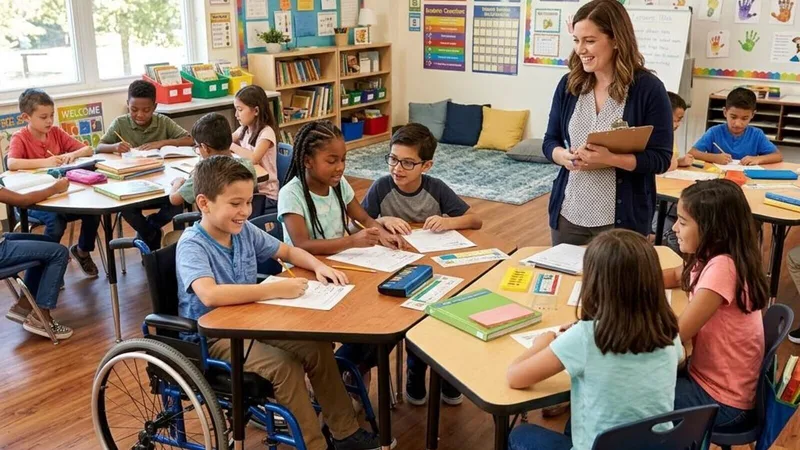
Inclusive education means students with disabilities learn in the same classrooms as students without disabilities, with the supports they need to succeed. It is more than a seat in the room. True inclusion means a student belongs. They take part in lessons, join clubs and field trips, make friends, and are held to high expectations just like everyone else.
Inclusion is not a favor to students with disabilities. It is a right. And decades of research show it works: students with disabilities in inclusive classrooms make stronger gains in reading and math, and their classmates without disabilities do just as well or better while learning empathy and teamwork along the way.
Education is the door to everything else
Why does inclusion matter so much? Because education is where opportunity begins. A student who learns to read, solve problems, and speak up for themselves becomes an adult who can work, live independently, and lead. A student who is excluded (kept in a separate room, given watered-down work, or treated as a visitor in their own school) misses more than lessons. They miss the chance to build the skills, confidence, and friendships that carry into adult life.
The numbers tell the story. People with disabilities are employed at far lower rates than people without disabilities, and the gap starts long before the first job application. Every year of real, inclusive education helps close it. Access to education creates access to jobs, to community life, and to independence.
Know your child's rights
Families are their children's strongest advocates, and the law is on your side. A few key protections to know as the year begins:
- IDEA. The Individuals with Disabilities Education Act guarantees eligible students a free appropriate public education in the least restrictive environment. That means schools must educate students with disabilities alongside their peers to the greatest extent possible.
- The IEP. Students who qualify under IDEA get an Individualized Education Program, a written plan with goals, services, and supports. Parents are equal members of the IEP team, and you can ask for a meeting at any time, not just once a year.
- Section 504. Students who don't qualify for an IEP may still get accommodations, like extra time, seating changes, or assistive technology, through a 504 plan.
- The ADA. The Americans with Disabilities Act requires schools to be physically and programmatically accessible, from the front door to the science lab to the school play.
Five ways families can start the year strong
- Review the plan now. Reread your child's IEP or 504 plan before the first day. Make sure it still fits. Kids change a lot over a summer.
- Meet the team early. A short, friendly email to the new teacher introducing your child, their strengths, their supports, and what helps them shine, sets a positive tone.
- Keep records. Save copies of plans, evaluations, and emails in one folder. Good notes make good meetings.
- Teach self-advocacy. Even young students can practice saying what they need. Self-advocacy is a life skill that starts at school and lasts forever.
- Ask for help when you need it. You don't have to navigate the system alone.
We're here for Lakeshore families
Disability Network Lakeshore helps families in Ottawa and Allegan counties understand their rights, prepare for school meetings, and connect with local resources, including the school-related supports listed on our resource directory. Our advocacy services and Information & Referral team are free for individuals. Call us at (616) 396-5326.
Here's to a school year where every student on the Lakeshore can participate, contribute, and belong.
Our world still has barriers for people with disabilities.
Whether you're an individual or a company, searching for disability resources is discouraging and frustrating. And when you don't have the right tools, individuals and communities suffer. Wouldn't you like to live in an inclusive community where everyone can participate, contribute, and belong?
The right resources are hard to find. We get it.
We understand how it feels to struggle to fully participate in an inaccessible community, which is why we help people find and use disability resources.