Every July, people across the country celebrate Disability Pride Month. It is a time to honor the lives, history, and gifts of people with disabilities. It is also a time to be proud of who we are, just as we are. Disability is a normal part of being human. More than one in four adults in the United States has a disability. Disability Pride Month reminds us that this large and diverse group deserves respect, a voice, and a full place in our community.
At Disability Network Lakeshore, we believe every person has worth. This month gives us a chance to share what disability pride means, why it matters, and how you can take part. You do not need to have a disability to join in. Everyone is welcome.
What is disability pride?
Disability pride means seeing disability as a part of who a person is, not as something to hide or fix. It means a person can feel good about their body, their mind, and their way of moving through the world. For a long time, people with disabilities were told to feel shame. Many were kept apart from school, work, and daily life. Disability pride pushes back on that old idea. It says that people with disabilities belong, and that their lives are full and valuable.
Pride does not mean pretending that life is always easy. Many people with disabilities face real barriers every day. Pride means facing those barriers with strength, and asking the world to change so everyone can take part. It is about the person and the community, not just one or the other.
Why July?
July is a special month for the disability community. On July 26, 1990, the Americans with Disabilities Act, or ADA, became law. This law made it illegal to treat people unfairly because of a disability. It opened doors to jobs, buildings, buses, and public spaces. It changed millions of lives.
The first Disability Pride Day was held in Boston in 1990, the same year the ADA passed. Over time, cities began to hold events all through July. Today, Disability Pride Month is marked with parades, art shows, talks, and gatherings around the world. It is both a celebration and a reminder that the work is not done.
The disability pride flag
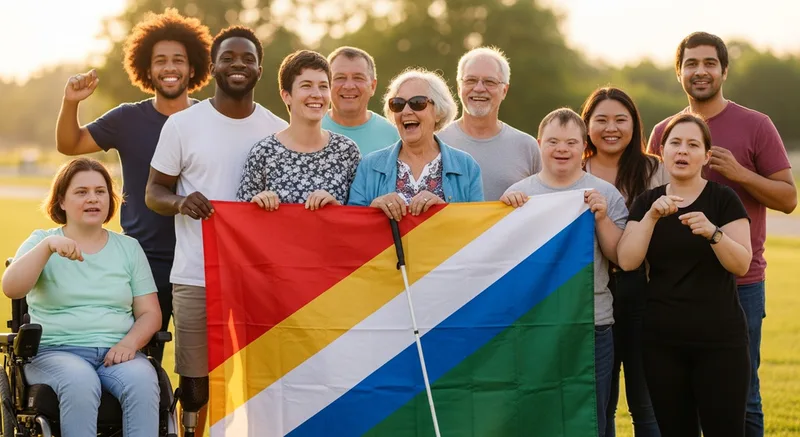
The disability pride flag is a strong symbol of the month. It has a charcoal gray background crossed by a band of five colored stripes. The gray stands for the people the community has lost to violence, neglect, and illness. It also honors those who have fought for their rights.
Each stripe has meaning. The colors stand for the many kinds of disability:
- Red stands for physical disabilities.
- Gold stands for neurodiversity, such as autism and other ways the brain works.
- White stands for disabilities that others cannot see and those not yet named.
- Blue stands for mental health and emotional disabilities.
- Green stands for sensory disabilities, such as being blind or Deaf.
The stripes run in a diagonal band, like a path cutting across a barrier. The flag was later updated with softer colors and a straighter design so that it would be easier and safer for people with visual sensitivities to view. The flag reminds us that the disability community is wide and varied, and that there is room for everyone in it.
Words matter
Disability Pride Month is a good time to think about the words we use. Kind, clear words help people feel seen. The best rule is simple: ask a person how they like to be described, and listen to their answer.
Some people prefer "person-first" language, such as "a person with a disability." This puts the person before the disability. Others prefer "identity-first" language, such as "a disabled person" or "an autistic person." For them, disability is a proud part of who they are. Both are right. What matters is respect. It also helps to skip old words that carry shame, and to avoid calling people "brave" or "inspiring" just for living their lives.
How to take part
You do not need to do anything big to honor Disability Pride Month. Small actions add up. Here are a few easy ways to join in:
- Learn. Read a book, watch a film, or follow creators with disabilities. Learn the history of the disability rights movement.
- Listen. When a person with a disability shares what they need, believe them. Their voice is the expert voice.
- Check for access. Look at your home, event, or workplace. Are there steps, narrow doors, or missing captions? Fix what you can.
- Speak up. If you see a place that is not accessible, ask for a change. Advocacy helps everyone.
- Celebrate. Go to a local event, share the disability pride flag, or simply tell a friend what the month is about.
Pride all year
Disability pride does not end when July ends. The goal is a world where people with disabilities can take part every day, in every space. That is the work we do at Disability Network Lakeshore all year long. We help people build skills, find resources, and live full lives on their own terms.
This July, we invite you to celebrate with us. Be proud of who you are. Make room for others. Together we can build a community where everyone belongs. If you or someone you love needs help finding disability resources, please call (616) 396-5326. We are located at 442 Century Lane, Holland, MI 49423, and our individual services are free.
Our world still has barriers for people with disabilities.
Whether you're an individual or a company, searching for disability resources is discouraging and frustrating. And when you don't have the right tools, individuals and communities suffer. Wouldn't you like to live in an inclusive community where everyone can participate, contribute, and belong?
The right resources are hard to find. We get it.
We understand how it feels to struggle to fully participate in an inaccessible community, which is why we help people find and use disability resources.